
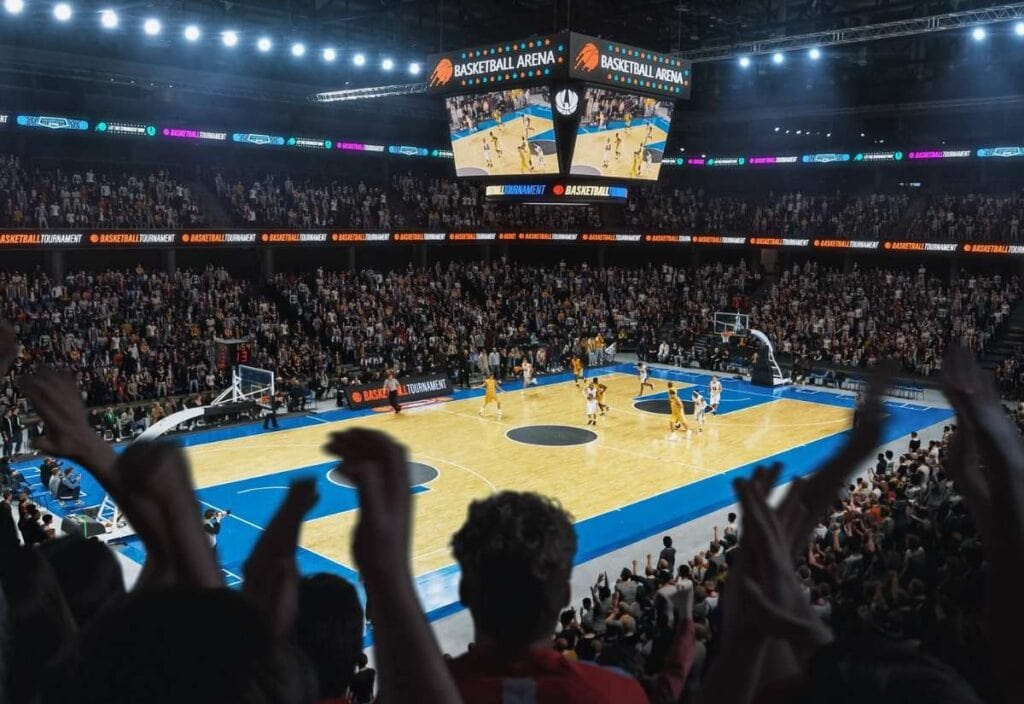
Host cities gear up for March Madness as the tournament turns brackets into packed downtown districts. As teams advance from one host city to the next, waves of fans, alumni groups and media crews follow close behind, filling flights and accommodations near arenas. Those arrivals boost sports tourism travel while testing transportation networks and public services during some of the busiest weeks on the local calendar.
This post may contain affiliate links that may earn us a commission. For more information, see our Disclosures.
While tournament travel delivers an economic boost, it also turns host cities into full-scale operations. Local officials brace for heavier movement around major venues by coordinating traffic control and safety coverage, with extended operating hours across nearby dining and entertainment corridors as game-day crowds come and go.
Tournament schedule guides travel
The National Collegiate Athletic Association Division I men’s basketball tournament brings together 68 teams and moves through several cities in the United States over multiple weeks. As the bracket progresses, fans, alumni groups and media crews move from one host city to the next, following their teams through each round.
The opening matchups, known as the First Four, take place in Dayton on March 17 and 18. First- and second-round games then spread across Buffalo, Greenville, Oklahoma City, Portland, Tampa, Philadelphia, San Diego and St. Louis, drawing traveling spectators into multiple regions at once.
Regional rounds shift the competition to larger arenas in Houston for the South Regional, San Jose for the West Regional, Chicago for the Midwest Regional and Washington for the East Regional. The season concludes with the Final Four in Indianapolis at Lucas Oil Stadium on April 4 and 6, concentrating national attention and a final wave of visitors in one destination.
Host cities handle visitor surge
Large tournaments place additional pressure on the daily pace of host cities, particularly in neighborhoods surrounding arenas and entertainment districts. Traffic volume increases as spectators move between hotels, restaurants and event venues throughout the day. Recent NCAA tournament hosts illustrate the scale of these visitor surges, with the 2025 men’s basketball tournament rounds in Raleigh bringing 21,315 unique visitors whose spending generated $707,804 in direct local tax revenue in a single weekend.
City officials work with law enforcement and emergency management teams to maintain safe movement near competition sites. Temporary street restrictions and designated ride-share pickup zones help guide vehicles through already busy corridors.
Emergency crews frequently increase staffing levels on game days to prepare for larger downtown crowds. Restaurants and bars near arenas also extend operating hours to accommodate fans gathering before tipoff and returning after late-night matchups.
Travel hubs control fan influx
Airports serve as the main entry points for tournament visitors, handling the arrival of teams, media personnel and large groups of spectators traveling to host cities. Demand tends to concentrate around game schedules, which fills seats quickly on routes linked to tournament locations. In San Antonio, for example, local officials expect more than 100,000 fans to arrive in the city to support their college teams during tournament events.
Many airlines respond by increasing capacity or adjusting aircraft size on high-demand routes, though ticket prices often rise as available seats shrink closer to game dates. Once flights arrive, transportation networks absorb the next wave of movement. Rental car counters, rail links and bus services connecting airports to downtown districts often experience heavier demand as visitors make their way to hotels and arenas.
Hotels brace for game crowds
Sports-related trips account for about 10% of tourism spending worldwide, and large tournaments quickly translate that movement into overnight stays across host markets. Hotel occupancy typically climbs during major competitions as fans secure rooms close to arenas and downtown districts.
Many spectators travel long distances and prioritize practical comforts after long days spent on the road and inside packed venues. Balanced breakfast options, laundry access and in-room storage or food preparation space often rank higher than leisure amenities during these short tournament stays.
Hotels in college sports destinations often lean into the atmosphere with themed decor, watch parties and gathering spaces for alumni groups following their teams. Some properties also coordinate transportation or shuttle services tied to game schedules to simplify trips between lodging and arenas. Short-term rentals also provide another option for visitors seeking extra space or proximity to competition venues, especially when hotel inventory is tight during busy tournament weekends.
Cities prove event readiness
As sports tourism grows, large tournaments increasingly function as complex travel events that require coordination across transportation networks, hotels and city services. Host cities rely on detailed planning to manage short bursts of visitors while keeping urban systems operating smoothly. With fan travel continuing to expand, future tournaments will likely place even greater demands on those infrastructures, making strategic preparation a central part of hosting major sporting events.
Zuzana Paar, a co-founder of Food Drink Life, is a seasoned traveler and writer who has explored 62 countries and lived in St. Lucia, Dubai, Vienna, Doha and Slovakia. Her work has been featured on Fox News, New York Daily News, MSN and more; she has also appeared live on Chicago’s WGN Bob Sirott Radio Show. When she’s not discovering new destinations, she shares travel tips and insider insights to help others experience the world in a unique and unforgettable way.