
Britain’s historic canals move at just 4 miles per hour, a pace set more than two centuries ago to protect waterways and boats. That gentle speed has become part of the draw. It turns narrowboat journeys into moving postcards of stone cottages, herons and lock gates, offering Americans a way to step straight into England’s slower, living history.
This post may contain affiliate links that may earn us a commission. For more information, see our Disclosures.
I noticed the difference as soon as I arrived at the boat yard in Bradford-on-Avon, a market town in England’s West Country. The pace shifted instantly, trading rush-hour stress for lock gates, aqueducts and landscapes that invite you to slow down. Traveling at canal speed made the trip more than sightseeing; it turned the journey itself into the story.
The magic of canal cruising speed
Before casting off from Bradford-on-Avon, I had a training session with Kev, an expert who has lived on a narrowboat for years. He explained that the 4-mile-an-hour pace isn’t just about charm; it’s a safeguard that keeps boats steady and waterways protected, a rhythm set centuries ago that still guides travel today.
Narrowboats on Britain’s canals were built for that speed, balanced by tradition and law, which meant I could settle in quickly. Kev stayed with us through the first lock, showing how to work the heavy gates, then stepped off the boat and left us to continue the trip on our own. From there, I was free to watch herons skim the water, pass stone cottages and wave to walkers along the towpath without worrying about speed or collisions.
Cruising canals in comfort
Once Kev left us, I realized how much the operator mattered. I was traveling with Drifters Waterway Holidays, where comfort and reliability showed in the details, from the way the boat handled to the thought put into its design.
Our narrowboat had a well-equipped kitchen and a separate bedroom, with just enough space for a small dining area. A flat-screen TV sat against the wall, though it was clear you don’t come here to watch television. For two of us, the boat was plenty big enough, but along the way, we met travelers who often booked larger boats than they needed just for extra room to move around.
The shower worked surprisingly well, and the stove came in handy. Still, part of the appeal was mooring up near a traditional pub and eating out. The boat had everything we needed, yet the mix of onboard comforts and canalside pubs made the experience feel like a holiday rather than a camping trip.
Settling in was easy. With Drifters’ support and the boat’s careful upkeep, even as a first-time boater, I felt confident continuing at canal speed.
Canal route highlights
From Bradford-on-Avon, I joined the Kennet & Avon Canal, one of Britain’s most scenic waterways. The canal runs for 87 miles, linking Bristol to Reading through rivers and canal cuts.
The stretch toward Bath was especially striking, weaving through the Avon Valley and climbing toward the famous Caen Hill Locks at Devizes. In total, the route includes 105 locks, a living showcase of Georgian engineering.
I found the mix of boats on the water fascinating. Alongside rental narrowboats like ours were liveaboard boats where families had made permanent homes. Talking with parents, I learned many had moored up because they couldn’t afford houses in areas with the best schools, so they chose boat life to give their children a stronger start. Roofs and decks held bicycles, pots of herbs and flowers, even solar panels, making them a floating glimpse of everyday life.
Wildlife was everywhere: sheep and cows grazing on the banks, horses watching from the fields and the occasional dog or cat padding along the towpath. And while the scenery felt quintessentially English, the people we met reflected a mix of nationalities. Many were Americans, delighted simply to try something different and discover a side of Britain they’d only seen in period dramas or guidebooks. Several told me they had considered U.S. river cruises on the Mississippi or Hudson but wanted something more hands-on. On the canals, you steer the boat yourself and move at a walking pace.
Today, the Kennet & Avon is managed by the Canal & River Trust and has become a hub for leisure, from boat hire to paddleboarding and cycling along the towpath. Starting from Bradford-on-Avon proved the perfect base for exploring this stretch of living history.
Benefits of slow travel on canals
The real benefit of traveling at 4 miles an hour was how predictable it felt. I could plan where to moor overnight, stop at a canalside pub or time a visit to a nearby attraction without any rush. That unhurried pace made the journey simple instead of stressful.
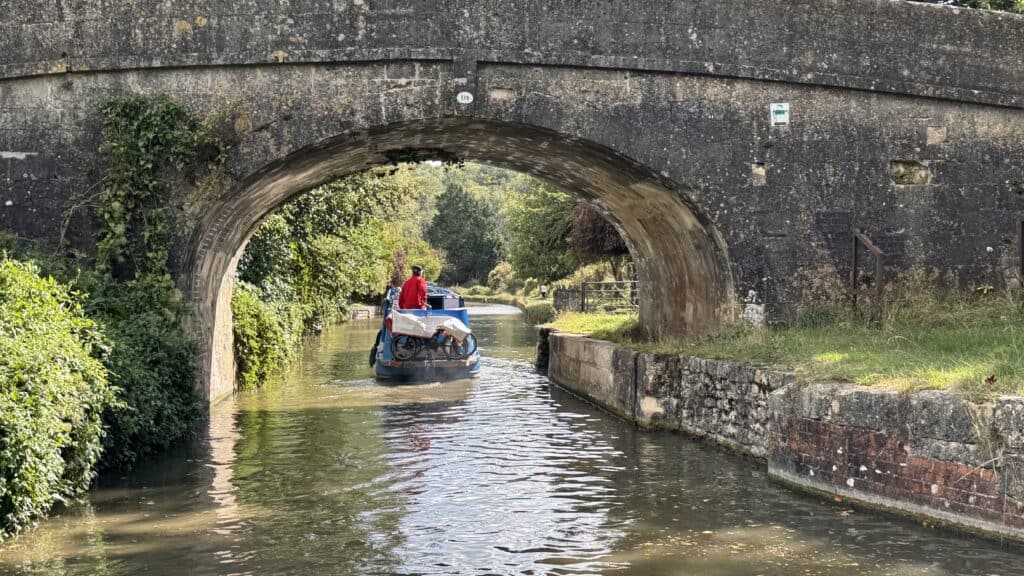
Moving that slowly also gave me more time to take in what we passed. The stone bridges were stunning, and the old buildings along the way were fascinating. Coming into Bath, history seemed to surface at every turn, from Georgian crescents above the waterline to the sense that the canal itself was part of a much larger story. Each mile offered its own reward, not just the finish line.
Drifting toward the finish line
Narrowboats rarely move faster than walking speed, and that’s the point. I love slow travel because it leaves space for conversations at the locks, evenings in pub gardens and a new way to approach places Americans often rush to tick off their list. It’s a sharp contrast to U.S. river cruises, where the focus is on covering distance. On Britain’s canals, the reward comes in moving slowly, one quiet mile at a time. For me, the real pleasure is in that gentle rhythm, not the destination.
Mandy is a luxury travel, fine dining and bucket list adventure journalist with expert insight from 46 countries. She uncovers unforgettable experiences around the world and brings them to life through immersive storytelling that blends indulgence, culture and discovery, and shares it all with a global audience as co-founder of Food Drink Life. Her articles appear on MSN and through the Associated Press Wire in major U.S. outlets, including NBC, the Daily News, Boston Herald, Chicago Sun-Times and many more.